Recently, I did a small experiment on ChatGPT and Google Bard. I would like to show the behaviour that I observed in both tools. I thought to do this for observing the response from both AI chatbot tools.
The Experiment:
The question that I have posted is “Can AI replace critical thinking? If yes, Justify how?”
(Note: I couldn’t able to take the full screenshot for some parts. So, so I have mentioned the full response below the screenshot)
Response from ChatGPT:
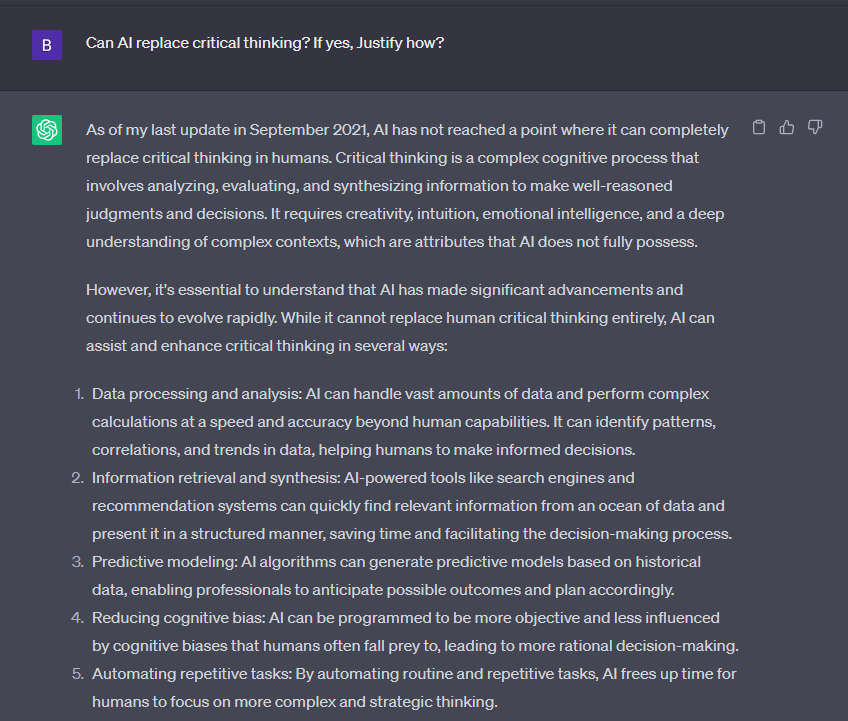
As of my last update in September 2021, AI has not reached a point where it can completely replace critical thinking in humans. Critical thinking is a complex cognitive process that involves analyzing, evaluating, and synthesizing information to make well-reasoned judgments and decisions. It requires creativity, intuition, emotional intelligence, and a deep understanding of complex contexts, which are attributes that AI does not fully possess.
However, it’s essential to understand that AI has made significant advancements and continues to evolve rapidly. While it cannot replace human critical thinking entirely, AI can assist and enhance critical thinking in several ways:
- Data processing and analysis: AI can handle vast amounts of data and perform complex calculations at a speed and accuracy beyond human capabilities. It can identify patterns, correlations, and trends in data, helping humans to make informed decisions.
- Information retrieval and synthesis: AI-powered tools like search engines and recommendation systems can quickly find relevant information from an ocean of data and present it in a structured manner, saving time and facilitating the decision-making process.
- Predictive modeling: AI algorithms can generate predictive models based on historical data, enabling professionals to anticipate possible outcomes and plan accordingly.
- Reducing cognitive bias: AI can be programmed to be more objective and less influenced by cognitive biases that humans often fall prey to, leading to more rational decision-making.
- Automating repetitive tasks: By automating routine and repetitive tasks, AI frees up time for humans to focus on more complex and strategic thinking.
- Natural Language Processing (NLP): AI-powered NLP systems can help analyze and summarize complex documents, making it easier for humans to extract critical information.
- Creativity augmentation: Some AI systems have shown potential in aiding human creativity, such as generating artistic works or assisting in design tasks.
Despite these capabilities, AI has limitations that prevent it from fully replacing critical thinking:
- Lack of consciousness and self-awareness: AI lacks self-awareness, emotions, and true consciousness, which are essential components of human critical thinking.
- Contextual understanding: AI struggles to comprehend the subtle nuances and context-dependent elements that are crucial in many critical thinking tasks.
- Ethical decision-making: AI lacks moral reasoning and ethical judgment, which are essential when dealing with complex ethical dilemmas.
- Adaptability and creativity: While AI can be trained on specific data, it may struggle to adapt to completely novel situations or generate entirely new ideas like humans can.
In summary, AI can be a powerful tool to augment and support critical thinking in humans, but it cannot replace the entirety of human cognitive abilities, especially the aspects that involve emotions, creativity, intuition, and deeper contextual understanding. Human and AI collaboration is likely to be the most effective approach in many critical thinking scenarios.
Response from Google Bard:
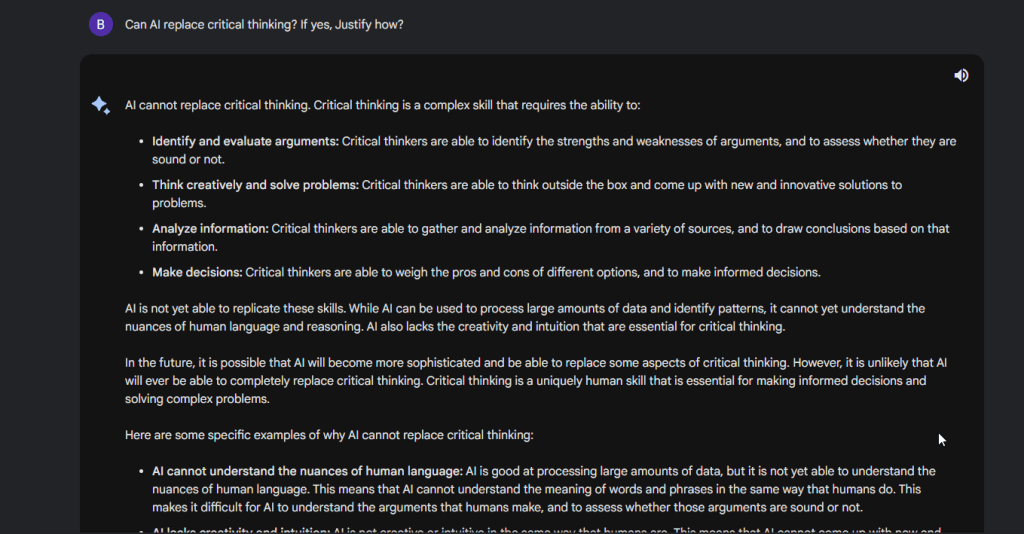
AI cannot replace critical thinking. Critical thinking is a complex skill that requires the ability to:
- Identify and evaluate arguments: Critical thinkers are able to identify the strengths and weaknesses of arguments, and to assess whether they are sound or not.
- Think creatively and solve problems: Critical thinkers are able to think outside the box and come up with new and innovative solutions to problems.
- Analyze information: Critical thinkers are able to gather and analyze information from a variety of sources, and to draw conclusions based on that information.
- Make decisions: Critical thinkers are able to weigh the pros and cons of different options, and to make informed decisions.
AI is not yet able to replicate these skills. While AI can be used to process large amounts of data and identify patterns, it cannot yet understand the nuances of human language and reasoning. AI also lacks the creativity and intuition that are essential for critical thinking.
In the future, it is possible that AI will become more sophisticated and be able to replace some aspects of critical thinking. However, it is unlikely that AI will ever be able to completely replace critical thinking. Critical thinking is a uniquely human skill that is essential for making informed decisions and solving complex problems.
Here are some specific examples of why AI cannot replace critical thinking:
- AI cannot understand the nuances of human language: AI is good at processing large amounts of data, but it is not yet able to understand the nuances of human language. This means that AI cannot understand the meaning of words and phrases in the same way that humans do. This makes it difficult for AI to understand the arguments that humans make, and to assess whether those arguments are sound or not.
- AI lacks creativity and intuition: AI is not creative or intuitive in the same way that humans are. This means that AI cannot come up with new and innovative solutions to problems. It also means that AI cannot make decisions that require a certain degree of “gut feeling.”
- AI is not able to learn from experience: AI can learn from data, but it cannot learn from experience in the same way that humans do. This means that AI cannot learn from its mistakes, and it cannot improve its performance over time.
In conclusion, AI cannot replace critical thinking. Critical thinking is a complex skill that requires the ability to understand human language, to be creative and intuitive, and to learn from experience. AI is not yet able to replicate these skills.
After this response, I posted another question, ” Can you summarize this in form of a mind map?”
Response from ChatGPT:
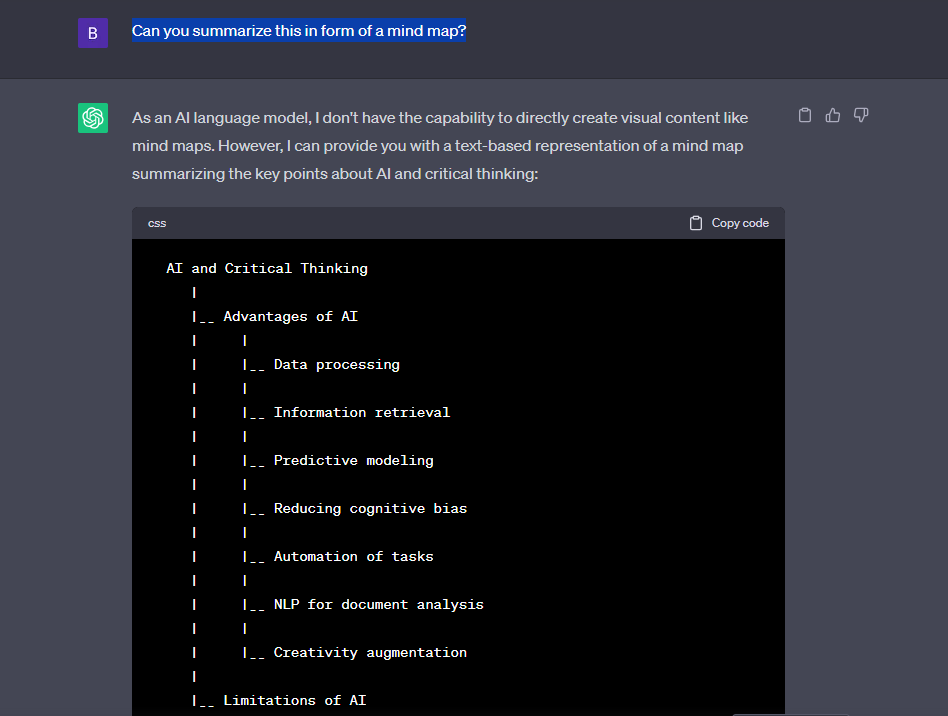
As an AI language model, I don’t have the capability to directly create visual content like mind maps. However, I can provide you with a text-based representation of a mind map summarizing the key points about AI and critical thinking:
  AI and Critical Thinking
     |
     |__ Advantages of AI
     |     |
     |     |__ Data processing
     |     |
     |     |__ Information retrieval
     |     |
     |     |__ Predictive modeling
     |     |
     |     |__ Reducing cognitive bias
     |     |
     |     |__ Automation of tasks
     |     |
     |     |__ NLP for document analysis
     |     |
     |     |__ Creativity augmentation
     |
     |__ Limitations of AI
           |
           |__ Lack of consciousness
           |
           |__ Inability to grasp context
           |
           |__ Lack of ethical decision-making
           |
           |__ Limited adaptability and creativity
Please visualize this mind map structure by creating it manually or using any mind mapping tool of your choice to have a more visually appealing representation.
Response from Google Bard:
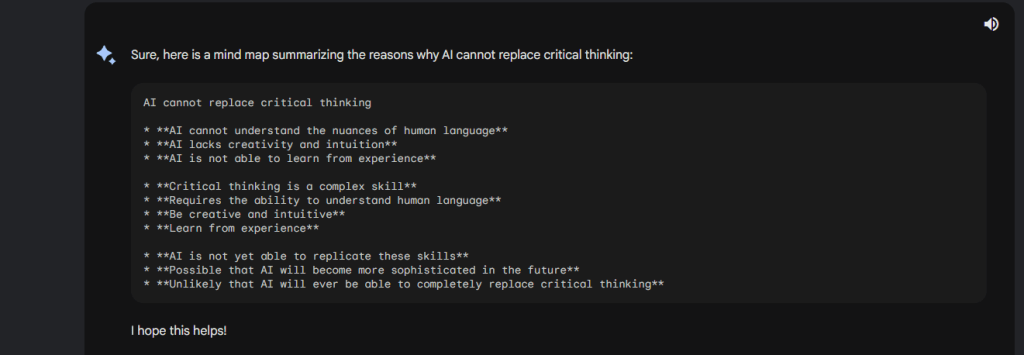
Sure, here is a mind map summarizing the reasons why AI cannot replace critical thinking:
AI cannot replace critical thinking

* **AI cannot understand the nuances of human language**
* **AI lacks creativity and intuition**
* **AI is not able to learn from experience**

* **Critical thinking is a complex skill**
* **Requires the ability to understand human language**
* **Be creative and intuitive**
* **Learn from experience**

* **AI is not yet able to replicate these skills**
* **Possible that AI will become more sophisticated in the future**
* **Unlikely that AI will ever be able to completely replace critical thinking**
I hope this helps!
Overall observation:
When I compared the response to the first question, I found that ChatGPT provided a lot of information than Google Bard. Also, ChatGPT provided a clear description of where AI can assist in critical thinking than Google Bard. Google Bard has provided a few examples only of why AI cannot replace critical thinking.
For the second question, ChatGPT was clearly stating its limitation on creating mind maps and also suggested using mind mapping tools. But Google Bard didn’t mention the limitation and displayed the summary in the bulleted form which is a bug.
So, why I thought to share this observation? because it won’t be that much good to stick with only one AI tool. We need to use different AI tools and know their advantages and limitations. Even AI and AI-related tools also have bugs. Be aware of those also.
So to my fellow testers, I would say to start using AI tools not only for productivity but also to try to find important bugs that might affect their value. This is the message I would like to convey to you all. Hope you find this short article useful.
Discover more from Bj Testing Talks
Subscribe to get the latest posts sent to your email.
 Bj Testing Talks
2 thoughts on “A small experiment with ChatGPT and Google Bard”